GHRP-2 vs GHRP-6
GHRP-2 and GHRP-6 are both hexapeptide growth hormone releasing peptides that stimulate GH secretion through the ghrelin receptor (GHS-R1a), but they differ in potency, selectivity, and side effect profiles. GHRP-2 is considered the more potent GH releaser with less appetite stimulation, making it preferred for lean body composition goals. GHRP-6 triggers a stronger ghrelin-like hunger response, which can be beneficial during bulking phases but problematic for those trying to control caloric intake. Both peptides also moderately elevate cortisol and prolactin — a key disadvantage compared to the newer, more selective ipamorelin.
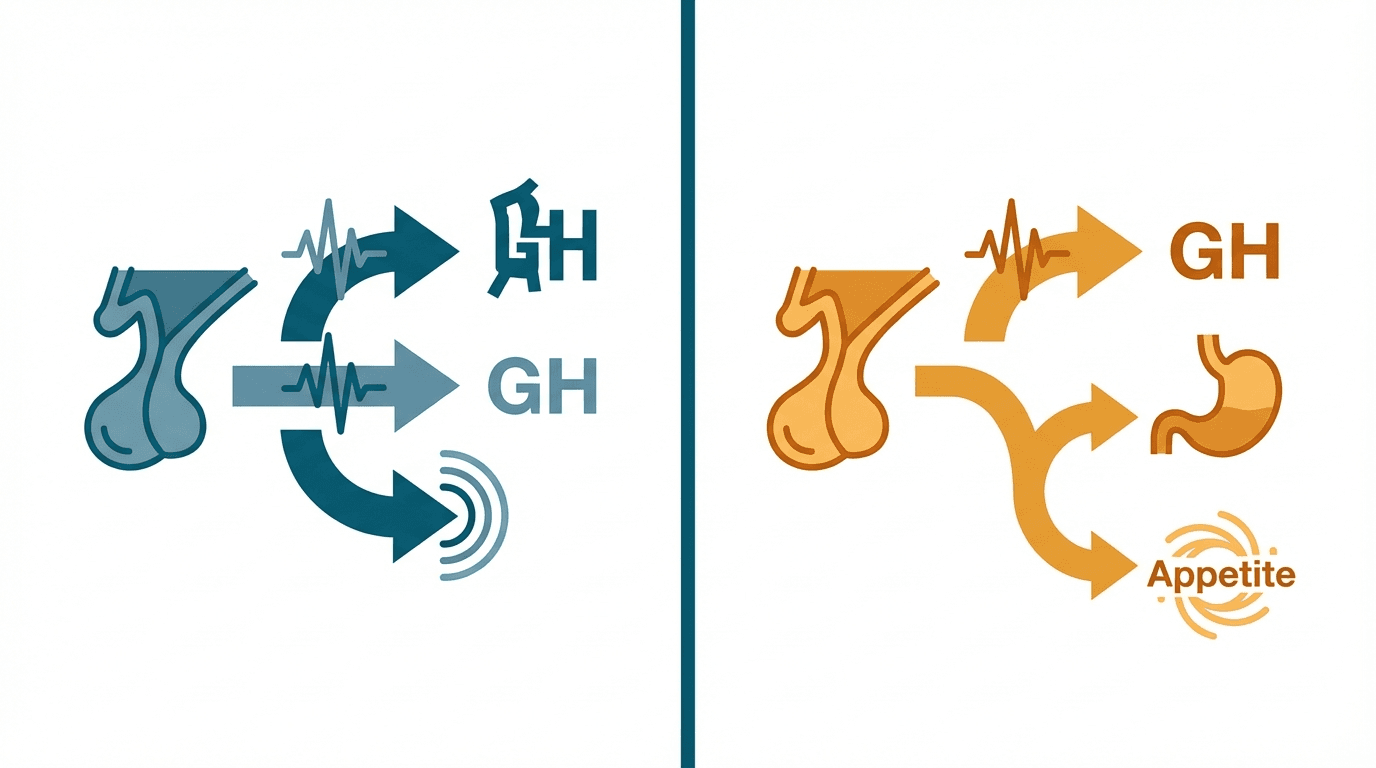
Head-to-Head Comparison
| Criteria | GHRP-2 | GHRP-6 |
|---|---|---|
| Primary mechanism | Ghrelin receptor (GHS-R1a) agonist with high GH release potency | Ghrelin receptor (GHS-R1a) agonist with strong ghrelin-mimetic activity |
| GH release potency | Slightly more potent GH release per mcg compared to GHRP-6 | Strong GH release but slightly less potent than GHRP-2 on a per-mcg basis |
| Appetite stimulation | Moderate — noticeable but manageable increase in hunger | Strong — intense hunger within 15–20 minutes of injection, lasting 30–60 minutes |
| Cortisol elevation | Moderate increase — higher than ipamorelin but generally tolerable | Moderate increase — similar to GHRP-2, dose-dependent |
| Prolactin elevation | Mild to moderate increase at standard doses | Mild to moderate increase — comparable to GHRP-2 |
| Typical dosage | 100–300 mcg subcutaneous, 2–3× daily | 100–300 mcg subcutaneous, 2–3× daily |
| Half-life | ~30 minutes (GH peak at 15–30 min post-injection) | ~20–30 minutes (GH peak at 15–30 min post-injection) |
| Effect on gastric motility | Minimal effect on gut motility | Increases gastric motility and stomach contractions (true ghrelin mimicry) |
| Ideal use case | Cutting or recomposition — strong GH release without overwhelming hunger | Bulking — strong GH release plus appetite stimulation supports caloric surplus |
| Synergy with GHRH analogs | Excellent — standard stack with CJC-1295 or sermorelin for synergistic GH pulse | Excellent — strong synergy with CJC-1295 or sermorelin |
| Research depth | Extensive — one of the most studied GHRPs with broad clinical trial data | Extensive — one of the earliest GHRPs discovered, well-characterized pharmacology |
| Approximate monthly cost | $30–$70 (research grade); $150–$300 (clinic) | $25–$60 (research grade); $150–$300 (clinic) |
When to Choose Each
Choose GHRP-2
Cutting and recomposition phases, users who want potent GH release without intense hunger, those stacking with GHRH analogs for maximum GH output
Choose GHRP-6
Bulking phases where increased appetite is desired, hard-gainers who struggle with caloric intake, users who want strong GH release and do not mind the hunger spike
Verdict
GHRP-2 is the better all-around choice for most users due to its slightly higher GH release potency and more manageable appetite stimulation. It is particularly well-suited for cutting, recomposition, or anyone who does not want dramatic hunger spikes. GHRP-6 is specifically useful during bulking phases where the intense appetite stimulation is a feature rather than a bug — it can help users who struggle to eat enough reach their caloric targets. Both peptides are inferior to ipamorelin in terms of selectivity (cortisol/prolactin impact), so users who prioritize clean GH release with no hormonal side effects should consider ipamorelin instead.
References
- Comparison of growth hormone releasing peptide-2 (GHRP-2) and growth hormone releasing peptide-6 (GHRP-6) on GH secretion in humans (1997) — PubMed
- Growth hormone-releasing peptides — mechanism and clinical applications (2002) — PubMed
- GHRP-2 stimulates GH secretion through hypothalamic and pituitary mechanisms (1999) — PubMed
- The growth hormone secretagogue receptor — a decade of discovery (2005) — PubMed
- Appetite-stimulating effects of growth hormone releasing peptide-6 and its analogs (2004) — PubMed
Frequently Asked Questions
Why not just use ipamorelin instead of GHRP-2 or GHRP-6?
How intense is the hunger from GHRP-6?
Should I worry about cortisol and prolactin elevation from these peptides?
How long should I cycle GHRP-2 or GHRP-6?
Are GHRP-2 and GHRP-6 legal to purchase?
Explore next
- Reconstitution CalculatorCalculate exactly how many units to draw on your syringe. Enter your vial size, bacteriostatic water volume, and desired dose.
- Dosage CalculatorFind evidence-based dosing ranges for any peptide. Adjust for body weight, experience level, and administration route.
- Cost CalculatorEstimate peptide costs per dose, per week, per month, and per year. Enter your vial price and dosing schedule to plan your budget.