SS-31 vs MOTS-c
SS-31 (elamipretide) and MOTS-c are both mitochondria-targeting peptides, but they work through fundamentally different mechanisms. SS-31 is a synthetic tetrapeptide that binds cardiolipin in the inner mitochondrial membrane to stabilize electron transport chain complexes and reduce reactive oxygen species (ROS) production. MOTS-c is an endogenous mitochondrial-derived peptide (MDP) encoded by mitochondrial DNA that activates AMPK signaling to regulate cellular metabolism, glucose homeostasis, and exercise adaptation. SS-31 is further along in clinical development with Phase 3 trials for mitochondrial myopathy and heart failure, while MOTS-c remains primarily in preclinical research with emerging human data on metabolic function.
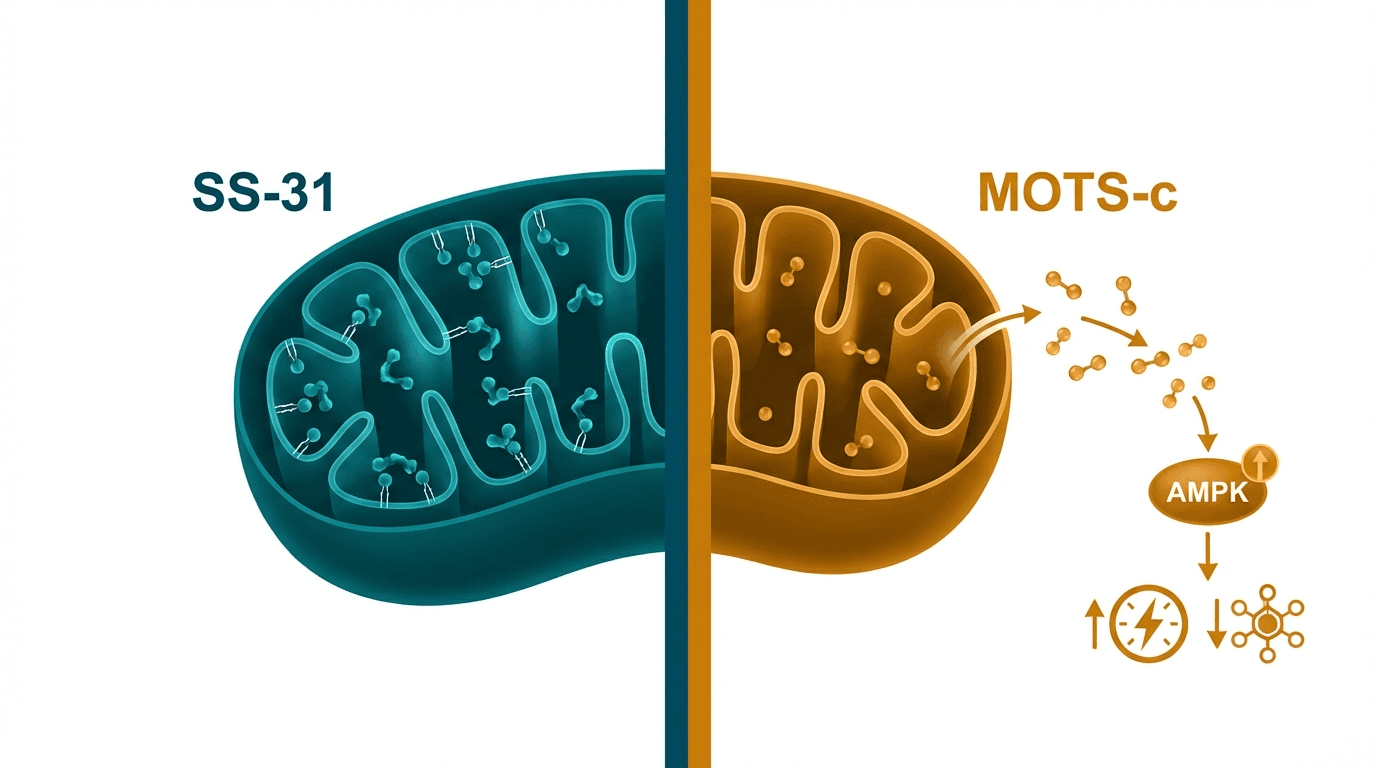
Head-to-Head Comparison
| Criteria | SS-31 | MOTS-c |
|---|---|---|
| Primary mechanism | Binds cardiolipin in inner mitochondrial membrane, stabilizes electron transport chain complexes, reduces ROS | Activates AMPK signaling pathway, regulates cellular metabolism and glucose uptake |
| Origin | Synthetic tetrapeptide (D-Arg-Dmt-Lys-Phe-NH₂) | Endogenous mitochondrial-derived peptide (encoded by 12S rRNA gene) |
| Primary target | Inner mitochondrial membrane — direct biophysical interaction with cardiolipin | Cytoplasmic and nuclear — AMPK activation, AICAR accumulation, gene regulation |
| Best for | Mitochondrial diseases (Barth syndrome, LHON), heart failure, ischemia-reperfusion injury, age-related mitochondrial decline | Metabolic dysfunction, insulin resistance, exercise performance, obesity, age-related metabolic decline |
| Route of administration | Subcutaneous injection or IV infusion (clinical trials) | Subcutaneous injection (research); endogenously produced during exercise |
| Clinical trial status | Phase 3 completed (Barth syndrome — TAZPOWER); Phase 2/3 for heart failure (multiple trials) | Preclinical with early human observational studies; no formal clinical trials completed |
| Effect on ROS | Directly reduces mitochondrial ROS production by stabilizing electron transport | Indirectly reduces oxidative stress via AMPK-mediated antioxidant gene expression |
| Effect on metabolism | Improves mitochondrial ATP production efficiency; minimal direct metabolic signaling | Directly enhances glucose uptake, fatty acid oxidation, and metabolic flexibility via AMPK |
| Exercise connection | May improve exercise tolerance in mitochondrial disease patients | Endogenous levels increase with exercise; may mimic exercise-induced metabolic benefits |
| Age-related decline | Restores cardiolipin structure that degrades with aging, reversing age-related mitochondrial dysfunction | Circulating levels decline with age; supplementation may restore youthful metabolic signaling |
| Safety profile | Well-tolerated in clinical trials; injection site reactions most common adverse event | Limited human safety data; animal studies show good tolerability |
| Research depth | Extensive — hundreds of preclinical papers, multiple Phase 2/3 clinical trials | Moderate — growing rapidly since discovery in 2015, mostly preclinical |
When to Choose Each
Choose SS-31
Mitochondrial diseases (Barth syndrome, primary mitochondrial myopathy), heart failure with mitochondrial dysfunction, ischemia-reperfusion protection, age-related mitochondrial decline
Choose MOTS-c
Metabolic syndrome and insulin resistance, exercise mimetic effects, age-related metabolic decline, obesity and glucose homeostasis, longevity-focused protocols
Verdict
SS-31 (elamipretide) is the stronger choice for individuals dealing with primary mitochondrial dysfunction, mitochondrial diseases, or cardiac conditions where direct stabilization of the electron transport chain is needed — it has the clinical trial data to back it. MOTS-c is more suited for metabolic optimization, insulin sensitivity, and mimicking the metabolic benefits of exercise, particularly in the context of aging and metabolic syndrome. For general longevity and anti-aging purposes, MOTS-c offers a broader metabolic signaling effect, while SS-31 provides targeted mitochondrial membrane repair.
References
- Mitochondria-targeted peptide SS-31 prevents mitochondrial depolarization, reduces islet cell apoptosis, and improves posttransplant function (2011) — PubMed
- MOTS-c is an exercise-induced mitochondrial-encoded regulator of age-dependent physical decline and muscle homeostasis (2021) — PubMed
- The mitochondrial-derived peptide MOTS-c: a player in exceptional longevity? (2020) — PubMed
- Elamipretide (SS-31) for Barth syndrome (TAZPOWER): a Phase 2/3 trial results (2022) — PubMed
- Szeto-Schiller peptides target mitochondria and reduce oxidative stress in aging (2014) — PubMed
Frequently Asked Questions
Can SS-31 and MOTS-c be used together?
Is SS-31 (elamipretide) available by prescription?
Does MOTS-c actually mimic exercise?
Why do MOTS-c levels decline with age?
How much do SS-31 and MOTS-c cost compared to each other?
Explore next
- Reconstitution CalculatorCalculate exactly how many units to draw on your syringe. Enter your vial size, bacteriostatic water volume, and desired dose.
- Dosage CalculatorFind evidence-based dosing ranges for any peptide. Adjust for body weight, experience level, and administration route.
- Cost CalculatorEstimate peptide costs per dose, per week, per month, and per year. Enter your vial price and dosing schedule to plan your budget.