GHK vs GHK-Cu
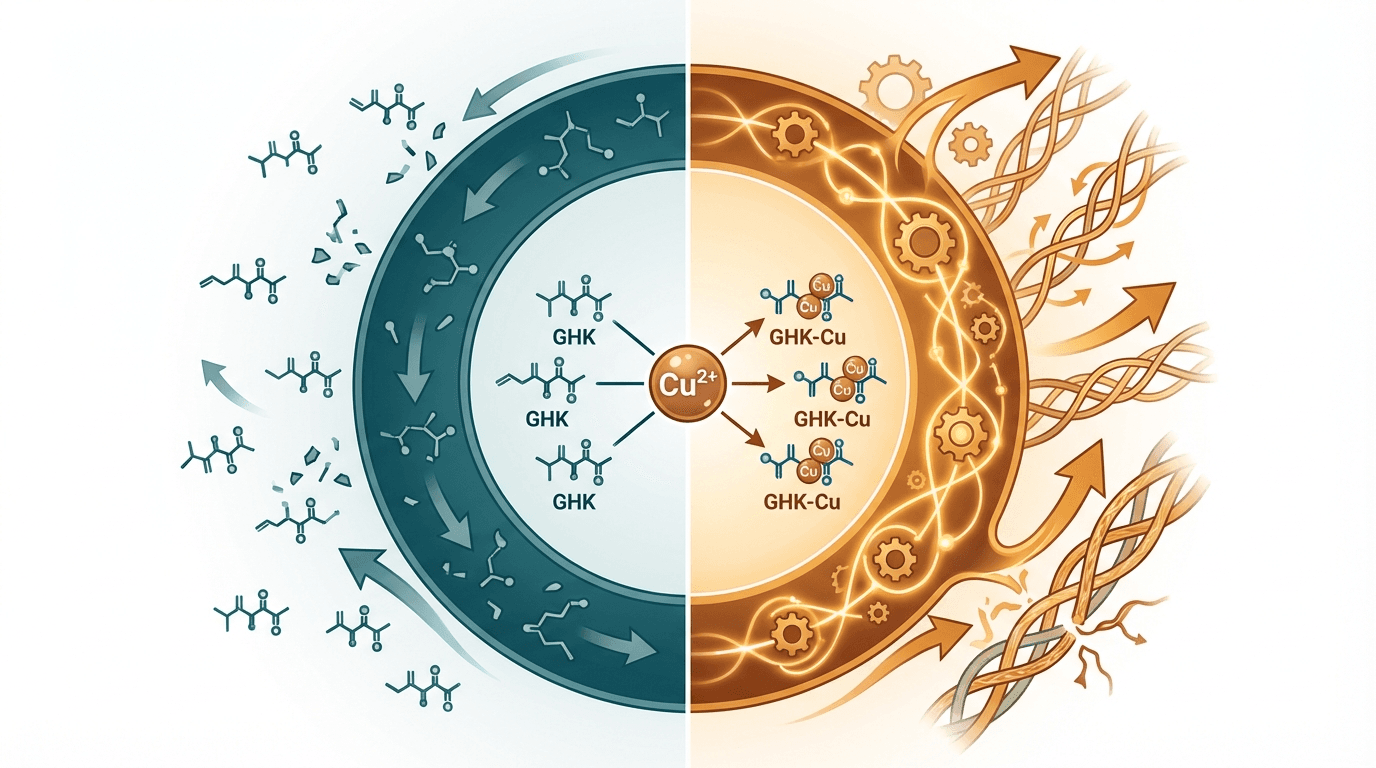
GHK and GHK-Cu are closely related — GHK is the free tripeptide (glycyl-L-histidyl-L-lysine) while GHK-Cu is the same peptide chelated with a copper(II) ion. GHK-Cu is the naturally occurring bioactive form found in human plasma, saliva, and urine, with copper binding essential for most of its regenerative activities including collagen synthesis, antioxidant defense, and gene expression modulation. While GHK alone can chelate endogenous copper in vivo, the vast majority of published research specifically studies the copper-bound GHK-Cu complex, making it the preferred and more predictable form for therapeutic use.
Head-to-Head Comparison
| Criteria | GHK | GHK-Cu |
|---|---|---|
| Chemical identity | Free tripeptide: Gly-His-Lys (no metal ion) | Copper(II) complex: Gly-His-Lys + Cu2+ chelated at histidine |
| Natural occurrence | Found in minimal quantities; rapidly binds available copper in vivo | Naturally present in human plasma (~200 ng/mL at age 20, declines with age) |
| Bioactive form | Prodrug — must chelate endogenous copper to become active | Directly bioactive — copper already bound and ready for biological function |
| Collagen stimulation | Indirect — depends on copper availability in target tissue | Direct — copper ion is integral to collagen I, III, and elastin upregulation |
| Gene expression modulation | Uncertain without copper; limited standalone gene expression data | Modulates 4,000+ human genes — resets gene expression toward a healthier pattern |
| Antioxidant activity | Weak without copper chelation | Strong — superoxide dismutase-like activity via copper ion |
| Wound healing evidence | Very limited standalone data | Extensive — multiple studies showing accelerated wound closure and remodeling |
| Commercial availability | Less common; available as research peptide | Widely available in skincare products (0.1–4%) and as injectable peptide |
| Skincare product use | Rarely used in formulations | Standard active ingredient in premium anti-aging serums and creams |
| Risk of copper depletion | Theoretical concern — may sequester copper from other essential enzymes | No concern — delivers copper to tissue rather than depleting it |
| Published research volume | Minimal standalone research | Extensive — Dr. Loren Pickart's research spanning 40+ years, hundreds of papers |
| Approximate cost | $20–$50 (research peptide) | $30–$60 (topical); $50–$100 (injectable) |
When to Choose Each
Verdict
GHK-Cu is the definitively preferred form for virtually all applications. The copper ion is not optional — it is integral to GHK's biological activity, driving collagen synthesis, antioxidant defense, anti-inflammatory gene expression, and tissue remodeling. Free GHK without copper may theoretically chelate endogenous copper to become active, but this is unpredictable, may deplete copper from other essential enzymes, and has almost no standalone research backing. Unless you have a specific reason to use free GHK (such as research purposes), GHK-Cu is the correct choice.
References
- GHK peptide as a natural modulator of multiple cellular pathways in skin regeneration (2015) — PubMed
- The human tripeptide GHK-Cu in prevention of oxidative stress and degenerative conditions of aging (2012) — PubMed
- Tripeptide GHK-Cu and tissue remodeling (2014) — PubMed
- GHK and DNA: resetting the human genome to health (2014) — PubMed
- Biochemical actions of the tripeptide GHK-Cu in wound healing and tissue repair (2020) — PubMed
Frequently Asked Questions
Is there any reason to use GHK instead of GHK-Cu?
Will free GHK just pick up copper from my body?
Why does GHK-Cu decline with age?
Can I just take copper supplements instead of GHK-Cu?
How do I know if a GHK-Cu product is high quality?
Explore next
- Reconstitution CalculatorCalculate exactly how many units to draw on your syringe. Enter your vial size, bacteriostatic water volume, and desired dose.
- Dosage CalculatorFind evidence-based dosing ranges for any peptide. Adjust for body weight, experience level, and administration route.
- Cost CalculatorEstimate peptide costs per dose, per week, per month, and per year. Enter your vial price and dosing schedule to plan your budget.