BPC-157 vs GHK-Cu
BPC-157 and GHK-Cu are both regenerative peptides but target different tissues and work through distinct mechanisms. BPC-157, a body protection compound derived from human gastric juice, excels at deep tissue repair through angiogenesis and growth hormone receptor upregulation — particularly in tendons, ligaments, and the GI tract. GHK-Cu is a naturally occurring copper tripeptide that drives collagen synthesis, elastin production, and extracellular matrix remodeling, making it the superior choice for skin rejuvenation, wound healing, and cosmetic anti-aging applications.
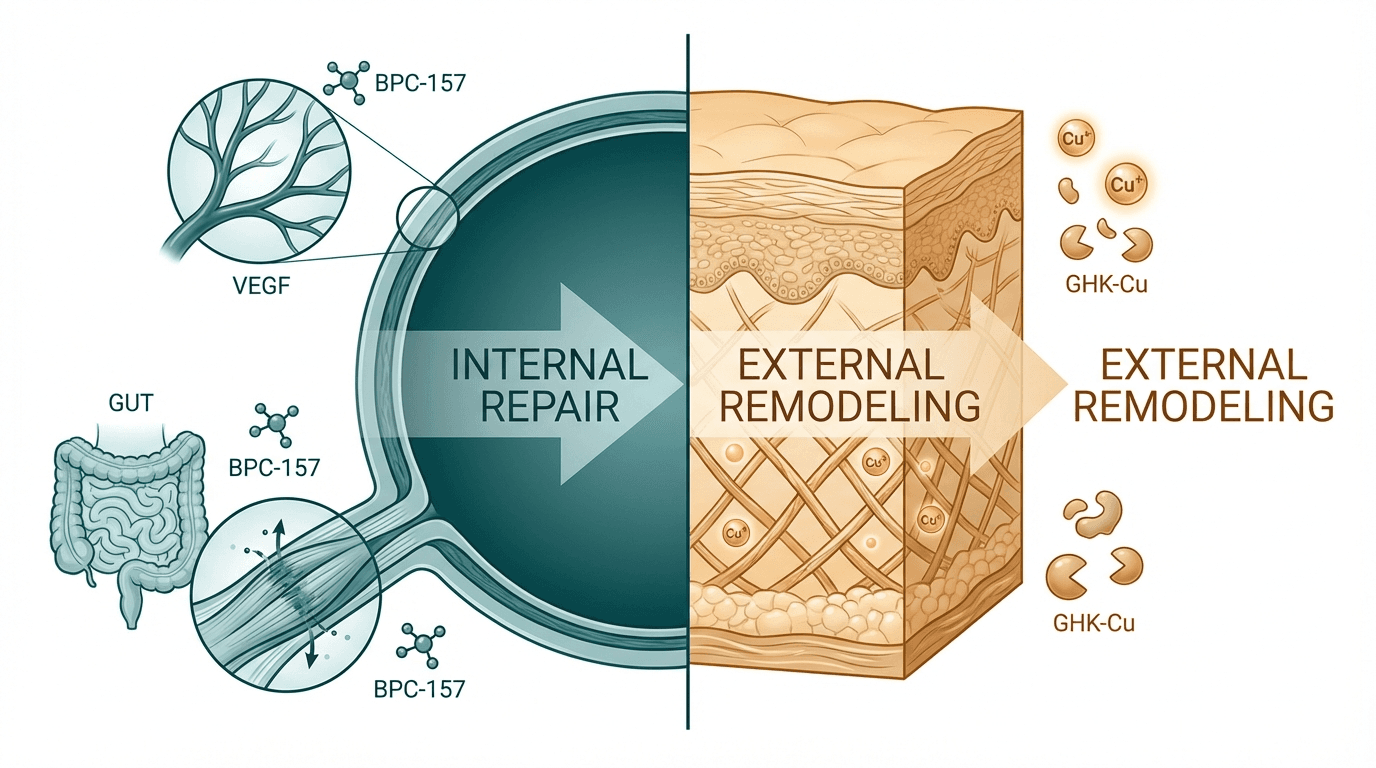
Head-to-Head Comparison
| Criteria | BPC-157 | GHK-Cu |
|---|---|---|
| Primary mechanism | Angiogenesis, GH receptor upregulation, nitric oxide modulation | Copper-dependent collagen synthesis, matrix metalloproteinase regulation |
| Best tissue targets | Tendons, ligaments, gut mucosa, muscle | Skin, hair follicles, superficial wounds, bone |
| Route of administration | Subcutaneous, intramuscular, or oral | Topical (cream/serum), subcutaneous, or intradermal |
| Oral bioavailability | Yes — stable in gastric acid | No — degraded orally; topical or injectable only |
| Typical dosage | 200–500 mcg, 1–2x daily (injectable); 500 mcg 2x daily (oral) | 1–2 mg daily (injectable); 1–4% cream (topical) |
| Anti-inflammatory action | Moderate — reduces inflammation secondary to tissue repair | Strong — directly suppresses pro-inflammatory cytokines (IL-6, TNF-alpha) |
| Collagen production | Indirect — via improved blood supply to injured tissue | Direct — upregulates collagen I, III, and elastin synthesis |
| Gut healing | Excellent — primary use case with extensive preclinical data | Not typically used for gut applications |
| Cosmetic / skin benefits | Minimal — not used in skincare protocols | Excellent — widely used in anti-aging serums and wound care |
| Hair growth potential | Minimal evidence | Moderate evidence — increases follicle size and hair thickness |
| Research status | Preclinical (extensive animal models) | Preclinical + limited human trials (wound healing, cosmetic) |
| Approximate monthly cost | $40–$80 (injectable); $50–$90 (oral) | $30–$60 (topical); $50–$100 (injectable) |
When to Choose Each
Verdict
BPC-157 is the clear winner for internal tissue repair — tendon injuries, gut healing, and musculoskeletal recovery — thanks to its angiogenic properties and unique oral bioavailability. GHK-Cu is the better choice for skin rejuvenation, cosmetic anti-aging, wound healing, and hair support due to its direct collagen-boosting and matrix-remodeling effects. For comprehensive healing that addresses both deep tissue and skin quality, the two peptides can be used together without known interactions.
References
- BPC 157 and its effects on the musculoskeletal system — a systematic review (2020) — PubMed
- GHK peptide as a natural modulator of multiple cellular pathways in skin regeneration (2015) — PubMed
- Pentadecapeptide BPC 157 enhances the growth hormone receptor expression in tendon fibroblasts (2010) — PubMed
- The human tripeptide GHK-Cu in prevention of oxidative stress and degenerative conditions of aging (2012) — PubMed
- Stable gastric pentadecapeptide BPC 157: novel therapy in gastrointestinal tract (2011) — PubMed
Frequently Asked Questions
Can BPC-157 and GHK-Cu be used together?
Which is better for post-surgical healing?
Is GHK-Cu the same as copper peptide in skincare products?
Which peptide has more human clinical data?
Are there any known side effects of BPC-157 or GHK-Cu?
Explore next
- BPC-157 dosage guideComprehensive BPC-157 dosage guide covering subcutaneous, intramuscular, and oral administration protocols. Includes reconstitution instructions, cycle guidance, stacking considerations, and references to published preclinical research on this gastric pentadecapeptide.
- GHK-Cu dosage guideEducational reference for GHK-Cu (copper peptide) dosage protocols including subcutaneous injection, topical application, and microneedling as discussed in published research.