Thymosin Alpha-1 vs Thymosin Beta-4
Thymosin alpha-1 and thymosin beta-4 are both derived from the thymus gland but serve fundamentally different biological roles. Thymosin alpha-1 (marketed as Zadaxin) is a 28-amino-acid immunomodulatory peptide that enhances T-cell maturation, dendritic cell activation, and antiviral/antitumor immune responses — it is approved in over 35 countries for hepatitis B and used as an immune adjuvant. Thymosin beta-4 is a 43-amino-acid peptide that drives tissue repair through actin sequestration, cell migration, and angiogenesis, making it the primary healing peptide of the thymosin family. Despite sharing a name origin, they target entirely different systems.
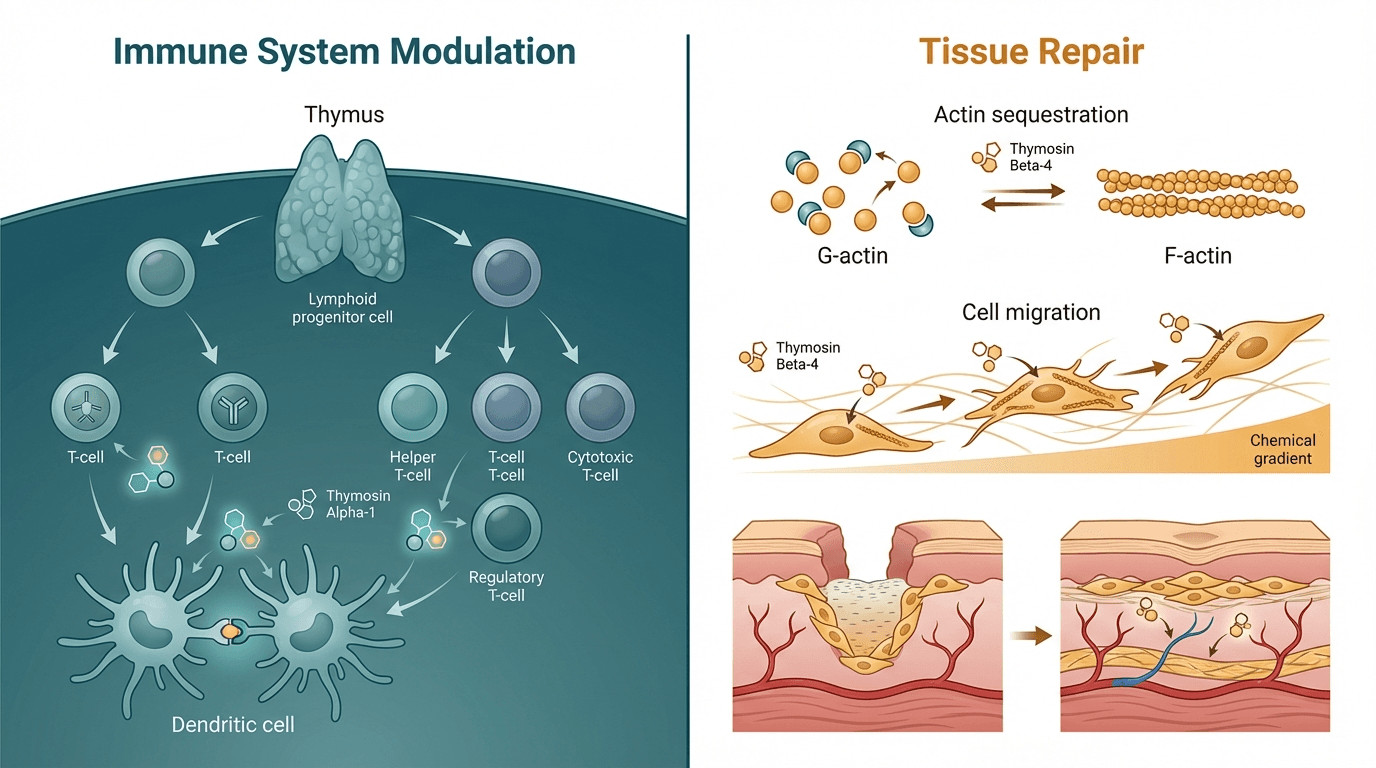
Head-to-Head Comparison
| Criteria | Thymosin Alpha-1 | Thymosin Beta-4 |
|---|---|---|
| Primary function | Immunomodulation — T-cell maturation, dendritic cell activation | Tissue repair — actin regulation, cell migration, angiogenesis |
| Amino acid length | 28 amino acids (acetylated at N-terminus) | 43 amino acids (the most abundant intracellular peptide) |
| Mechanism of action | Activates toll-like receptors (TLR9), enhances MHC class I expression, stimulates NK cells | Sequesters G-actin monomers, promotes cell migration and blood vessel formation |
| Primary target system | Immune system — adaptive and innate immunity | Musculoskeletal and cardiovascular — tissue regeneration |
| Regulatory status | Approved as Zadaxin in 35+ countries (hepatitis B/C); orphan drug status in US | No regulatory approval; available as research peptide (TB-500 is the active fragment) |
| Route of administration | Subcutaneous injection (1.6 mg standard dose) | Subcutaneous or intramuscular injection |
| Typical dosage | 1.6 mg, 2x weekly (approved dose); up to 3.2 mg in some protocols | 2.0–5.0 mg, 2x weekly (as TB-500 fragment) |
| Hepatitis B/C treatment | Yes — approved indication in multiple countries; improves viral clearance | Not used for viral infections |
| Cardiac repair | Indirect — may support immune-mediated cardiac recovery | Direct — promotes cardiomyocyte survival, angiogenesis in ischemic heart tissue |
| Cancer immunotherapy adjuvant | Yes — studied as immune adjuvant with chemotherapy and checkpoint inhibitors | Not used in oncology; theoretical concern about promoting angiogenesis near tumors |
| Wound/injury healing | Indirect — supports immune component of healing | Primary use case — accelerates healing of tendons, muscles, and wounds |
| Safety profile | Excellent — extensive human safety data from approved use worldwide | Preclinical — extensive animal safety data, limited formal human trial data |
When to Choose Each
Choose Thymosin Alpha-1
Immune system enhancement, chronic hepatitis B/C, cancer immunotherapy adjunct, post-infection immune recovery, immunocompromised patients, vaccine response optimization
Choose Thymosin Beta-4
Musculoskeletal injury healing, cardiac repair post-MI, tendon and ligament recovery, wound healing, systemic tissue regeneration, sports injury recovery
Verdict
Thymosin alpha-1 and thymosin beta-4 are not interchangeable — they serve completely different purposes despite their shared thymic origin. Thymosin alpha-1 is the choice for immune enhancement: chronic infections (hepatitis B/C, HIV adjunct), immune deficiency, cancer immunotherapy support, and post-viral immune recovery. Thymosin beta-4 (or its fragment TB-500) is the choice for tissue repair: musculoskeletal injuries, cardiac damage, wound healing, and systemic recovery from physical trauma. Thymosin alpha-1 has the significant advantage of regulatory approval and extensive human clinical data, while thymosin beta-4 remains a research peptide with strong preclinical evidence.
References
- Thymosin alpha 1 — a peptide immune modulator with a broad range of clinical applications (2014) — PubMed
- Thymosin beta-4 promotes angiogenesis, wound healing, and hair follicle development (2006) — PubMed
- Thymalfasin (thymosin alpha-1) in the treatment of hepatitis B and C (2007) — PubMed
- Thymosin beta-4 activates integrin-linked kinase and promotes cardiac cell migration, survival, and cardiac repair (2004) — PubMed
- Thymosin alpha-1 as an immunomodulatory agent for treatment of cancer and hepatitis (2017) — PubMed
- Actin sequestering protein thymosin beta-4 in inflammation and tissue remodeling (2016) — PubMed
Frequently Asked Questions
Are thymosin alpha-1 and thymosin beta-4 related?
Can thymosin alpha-1 and thymosin beta-4 be used together?
Why is thymosin alpha-1 approved but thymosin beta-4 is not?
What is TB-500 and how does it relate to thymosin beta-4?
How do thymosin alpha-1 and thymosin beta-4 compare in cost and availability?
Explore next
- Reconstitution CalculatorCalculate exactly how many units to draw on your syringe. Enter your vial size, bacteriostatic water volume, and desired dose.
- Dosage CalculatorFind evidence-based dosing ranges for any peptide. Adjust for body weight, experience level, and administration route.
- Cost CalculatorEstimate peptide costs per dose, per week, per month, and per year. Enter your vial price and dosing schedule to plan your budget.